
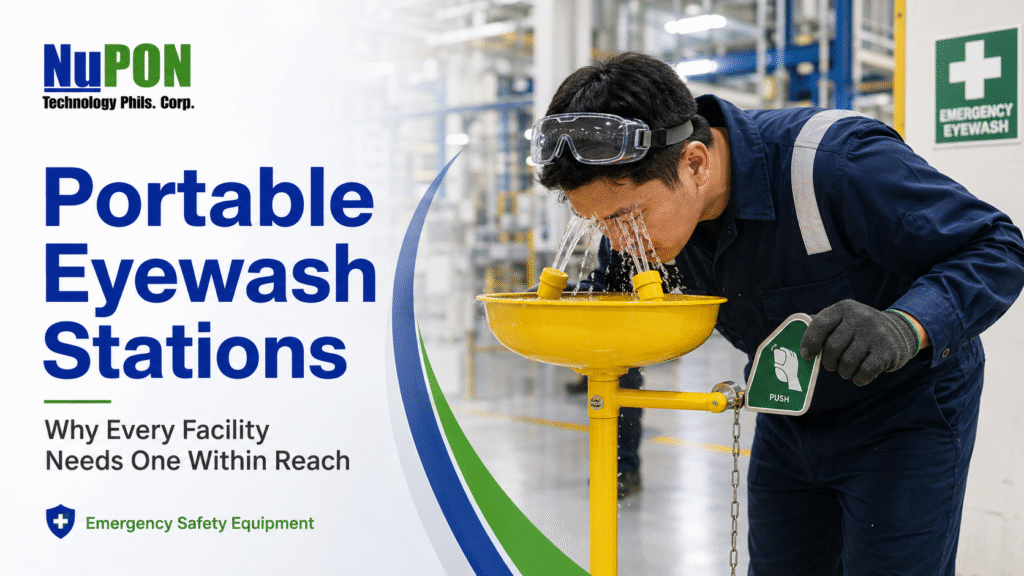
A portable eyewash station is a self-contained, gravity-fed or bottle-type unit that delivers immediate eye flushing when a plumbed eyewash isn’t accessible. DOLE’s Occupational Safety and Health Standards require appropriate emergency facilities wherever workers face hazardous exposure, and industry practice specifies that equipment against ANSI/ISEA Z358.1 — meaning flushing equipment must sit within a 10-second, unobstructed path of the hazard. Portable units are what make that achievable across Philippine sites: PEZA electronics plants, construction sites, rooftop solar installations, and warehouses without nearby plumbing.
The First 15 Seconds Decide the Outcome
Eye injuries move fast, and the numbers in the Philippines back that up. According to the Philippine Statistics Authority’s 2021/2022 Integrated Survey on Labor and Employment, manufacturing accounted for 41.7% of all occupational injuries with lost workdays that year — by far the highest share of any industry group, ahead of agriculture/forestry/fishing and administrative support services combined. DOLE’s own incident tracking for January–July 2025 recorded 217 reported workplace accidents nationwide, resulting in 153 deaths and 255 injuries — averaging close to one workplace fatality a day across Philippine industry.
Chemical and particulate exposure is a recurring thread in that data, and the physiology behind it is unforgiving: corrosive agents keep reacting with ocular tissue for as long as they remain in contact with the eye, which is why the first 10 to 15 seconds after a splash largely determine how much lasting damage occurs. The response protocol is not up for debate: flush the affected eye continuously with clean water or saline for a minimum of 15 minutes — longer for alkali exposures — starting within the first minute of contact. That single fact is the entire reason emergency eyewash equipment exists, and it’s why “the nearest sink” is not an acceptable substitute in any Philippine facility working with acids, alkalis, solvents, or particulate-generating processes.
The Technical Benchmark Behind Every Compliant Unit
Philippine OSH regulations set the legal obligation to provide emergency flushing facilities wherever corrosive or hazardous materials are handled — but they don’t spell out flow rates, water temperature, or valve mechanics down to the millimeter. For that level of technical detail, Philippine safety officers, equipment suppliers, and PEZA-zone facilities overwhelmingly specify against ANSI/ISEA Z358.1, the internationally recognized performance standard for emergency eyewash and shower equipment. It’s the de facto engineering reference NTPC uses when sourcing and recommending units, precisely because it turns “provide suitable facilities” into measurable, testable numbers. Key performance requirements include:
- Flow rate: minimum 0.4 gallons per minute (1.5 L/min) for eyewash-only units, 3.0 GPM for eye/face wash units
- Duration: a full 15 minutes of continuous, hands-free flushing fluid
- Water temperature: “tepid” — between 16°C and 38°C (60–100°F), since water that’s too cold drives workers to stop flushing early (risking hypothermia), and water that’s too hot can accelerate the chemical reaction on the skin and eyes
- Accessibility: reachable within 10 seconds, on the same level as the hazard, with no locked doors or obstructions in the path
- Activation: the valve must go from off to full flow in one second or less, and stay on without the user having to hold it
An important nuance the standard is explicit about: personal eyewash bottles and small personal wash units are classified as supplemental equipment, not a substitute for a compliant primary station. They’re designed to provide immediate first-response flushing while the injured worker moves toward a full-capacity unit — not to complete the entire 15-minute protocol on their own.
Why “Portable” Solves a Real Gap
Plumbed, wall-mounted eyewash stations are the gold standard where fixed infrastructure exists. But a large share of real-world hazard exposure happens in places with no plumbing nearby: temporary construction sites, solar panel installation zones, warehouse loading bays, mobile maintenance carts, remote tank farms, and satellite work areas inside larger plants. In those settings, a self-contained portable eyewash — one that carries its own pressurized or gravity-fed water supply and meets the same flow-rate and duration requirements — is the only way to stay compliant without re-routing plumbing to every corner of a site.
This is precisely the gap NuPON’s portable eyewash line is built to close, and it maps to a wide range of industries already on our client roster:
- Electronics and semiconductor manufacturing (PEZA-zone factories using etchants, flux, and cleaning solvents)
- Chemical mixing, blending, and distribution operations
- Battery assembly and charging stations (sulfuric acid exposure risk)
- Metal fabrication and abrasive blasting (dust, grit, and surface-treatment chemicals)
- Solar panel installation and PV cleaning crews, who often work on rooftops or field sites with zero plumbing access
- Cleanroom and laboratory environments handling reagents and IPA-based solutions
- Construction and civil works using cement, epoxy, and sealants that are highly alkaline
NuPON’s Portable Eyewash Lineup
NuPON Technology Phils. Corp. carries a full range of portable and self-contained eyewash equipment under our PPE and Emergency Response line, sized for different risk levels and mobility needs:
14 Gallon Portable Eyewash
A high-capacity, floor-standing gravity-feed unit built from polyethylene, holding 53 liters (14 gallons). It delivers a 3 liter/minute nozzle output at 1–3 kg/cm² pressure — well above the ANSI minimum flow rate — making it suitable as a primary compliant station for chemical storage areas, laboratories, factory floors, and construction sites where a 15-minute continuous flush needs to be genuinely achievable, not just implied.
Portable Eyewash with Cart
A 9-gallon (34-liter) wheeled unit molded from non-toxic PE, finished in high-visibility bright green. NuPON’s own product data confirms it can sustain more than 15 minutes of continual flow — meeting the core ANSI duration requirement while remaining mobile enough to reposition as work zones shift, which matters on active construction or maintenance sites.
Portable Dual Emergency Eyewash
A compact, non-toxic PP twin-bottle unit (2 × 500ml, green housing, 26×28×14cm mounting plate) designed for immediate first-response flushing at the point of hazard — a workbench, a chemical storage cabinet, a mobile cart. This is supplemental equipment under ANSI Z358.1: ideal for the critical first seconds of exposure, but it should always be paired with a full-capacity station like the 14-Gallon or Cart unit nearby, not used as the sole emergency response option.
The full catalog also includes gravity-feed portable units, single-bottle personal eyewash bottles, wall- and pedestal-mounted stations in ABS or stainless steel bowl finishes, combination shower-and-eyewash units, and individual replacement parts (foot pedals, pull rods, shower bowls, valve assemblies) for facilities maintaining existing installations.
The Philippine Compliance Picture
Occupational eye-wash provisioning in the Philippines sits under two layers of regulation. The older and still-referenced layer is the DOLE Occupational Safety and Health Standards (“the yellow book”), specifically Rule 1960 — Occupational Health Services, which covers hazardous-workplace emergency health provisions and obligates employers to furnish appropriate emergency facilities wherever hazardous exposure is possible. Layered on top of that is RA 11058, the Act Strengthening Compliance with Occupational Safety and Health Standards, and its implementing rules. For several years, the operative IRR was DOLE Department Order No. 198-18 — the reference most safety officers, including many working from NTPC’s own ESH documentation, have cited by default.
That has since changed: DOLE issued Department Order No. 252-25 in 2025, adopting a Revised IRR of RA 11058 that formally supersedes D.O. 198-18. The revised rules broaden coverage to all establishments, projects, and worksites regardless of industry or location — removing some of the narrower risk-classification carve-outs in the old order. Any HIRAC, ESH Plan, or Work Permit documentation still citing D.O. 198-18 as the governing IRR is worth a review against D.O. 252-25 to confirm continued alignment.
Under this framework, employers are expected to identify where corrosive, toxic, or irritant substances are stored, handled, or processed, and provide emergency flushing equipment appropriately located and maintained relative to that hazard — the same underlying logic ANSI Z358.1 codifies in more granular technical detail.
Maintenance Isn’t Optional
An eyewash station that hasn’t been checked in months is not a safety control — it’s a liability with a green sticker on it. Self-contained portable units need particular attention because stagnant water breeds bacteria:
- Visually inspect self-contained portable units weekly to confirm flushing fluid hasn’t degraded or evaporated
- Replace or treat the water supply on the schedule specified by the manufacturer — typically every 90–180 days for untreated water
- Confirm the activation mechanism still triggers in one second or less
- Keep the 10-second access path completely clear of stored materials, pallets, or locked doors
- Log every inspection as part of your facility’s OSH documentation trail
Frequently Asked Questions
How long should an eye be flushed after chemical exposure?
A minimum of 15 minutes of continuous flushing with clean water or saline, starting as soon as possible after contact — longer for alkali or strongly caustic substances, per ANSI Z358.1 and standard emergency medicine guidance.
Is a personal eyewash bottle enough on its own?
No. ANSI Z358.1 classifies bottle-type and small personal wash units as supplemental equipment only. They cover the critical first moments of exposure, but a full-capacity station capable of a genuine 15-minute flush must be within reach as well.
Do portable eyewash stations need to be plumbed in?
No — that’s their purpose. Self-contained portable and gravity-feed units carry their own water supply, which is what makes them viable for construction sites, rooftop solar installations, and other locations without existing plumbing.
What’s changed in Philippine OSH regulations recently?
DOLE issued Department Order No. 252-25 in 2025, adopting a Revised IRR of RA 11058 that supersedes the previous D.O. 198-18 and extends coverage to all establishments regardless of industry or location.
NuPON Technology Phils. Corp. supplies portable and fixed emergency eyewash and shower equipment, along with the full range of PPE, ESD, and cleanroom products, to industrial facilities across the Philippines. Browse the complete eyewash and emergency response line at nuponcorpphils.com, or reach our team directly via WhatsApp for stock availability and site-specific recommendations.