
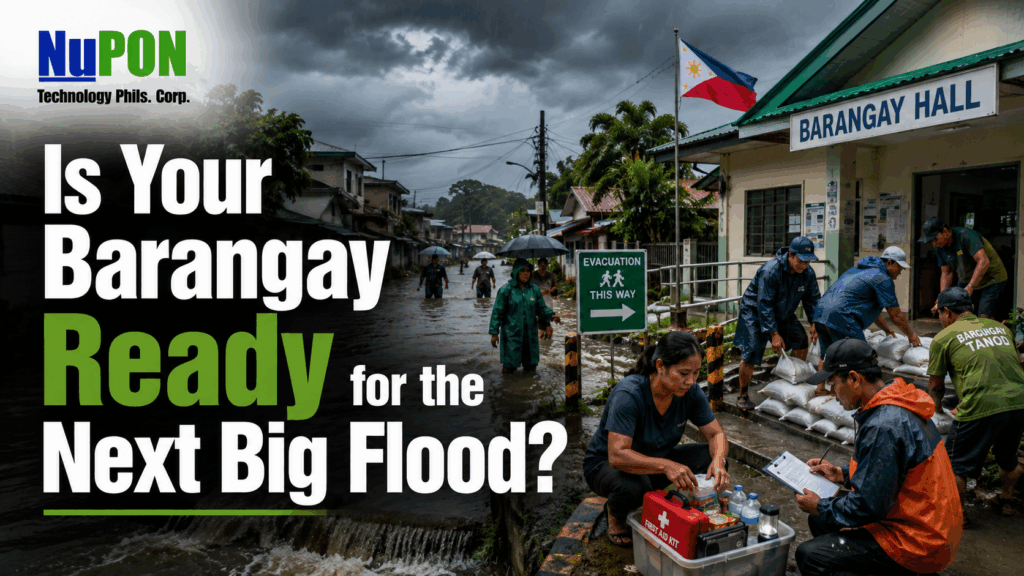
Flood-rescue preparedness for Philippine LGUs requires three core categories of equipment: water-rescue devices (rescue boats, remote-controlled rescue buoys, life rings), personal flotation equipment (life vests, helmets), and communication systems (two-way radios, GPS trackers).
Under Republic Act No. 10121, every barangay, city, and municipal DRRM office is required to maintain search-and-rescue capability funded through the Local DRRM Fund (LDRRMF).
Typhoon season in the Philippines is no longer a once-a-year event — it is a recurring emergency that local government units must continuously prepare for. In 2025 alone, Typhoon Fung-wong displaced more than 1.4 million people and caused flooding that submerged entire towns in Cagayan Valley. In February 2026, Tropical Storm Basyang caused fatalities from drowning across Mindanao and the Visayas. These are not isolated events — they are the new normal for disaster planning in the Philippines.
For Barangay Disaster Risk Reduction and Management Committees (BDRRMCs), City/Municipal DRRM Offices (LDRRMOs), and procurement officers tasked with disaster preparedness, the question is not if the next flood will come, but whether your rescue equipment inventory is ready when it does. This guide covers what flood rescue equipment your LGU needs, how it ties to RA 10121 compliance, and how to plan your procurement before typhoon season — not during it.
Why Flood Rescue Preparedness Cannot Wait Until Typhoon Season
Most flood-related drowning deaths in the Philippines happen in the first 24 to 48 hours of a flash flood event — precisely when rescue teams are most likely to be under-equipped, overwhelmed, or still waiting for equipment requests to clear procurement channels. Disaster response data from past typhoons consistently shows the same pattern: missing fishermen swept away by flash floods, residents trapped on rooftops, and rescue teams arriving without the right tools to reach them safely.
Waiting until a typhoon signal is raised to assess your barangay’s or city’s rescue equipment inventory is already too late. Equipment procurement, especially anything funded through public funds, requires lead time for budgeting, bidding, and delivery — all of which must be completed during the dry season, well before the first storm signal of the year.
RA 10121 and the Legal Basis for LGU Rescue Equipment
The Philippine Disaster Risk Reduction and Management Act of 2010 (RA 10121) establishes the legal foundation for disaster preparedness at every level of local government. Under this law:
- Every province, city, and municipality must establish a Local Disaster Risk Reduction and Management Office (LDRRMO)
- Every barangay must establish a Barangay Disaster Risk Reduction and Management Committee (BDRRMC), supervised by the Barangay Development Council (BDC)
- LDRRMOs and BDRRMCs are responsible for organizing, training, and directly supervising local emergency response teams
- A Local DRRM Fund (LDRRMF) must be set aside annually from the LGU budget specifically for disaster preparedness, response, and mitigation — including equipment procurement
- Purchases made using DRRM funds must comply with the Commission on Audit (COA) and the Philippine procurement law guidelines
In practice, this means flood rescue equipment is not just a recommendation — it is a budgeted, legally mandated responsibility for every LGU in the Philippines. The challenge for most procurement officers is translating this mandate into a practical, complete equipment list.
Essential Flood Rescue Equipment for LGUs
A complete flood and water rescue equipment inventory falls into four categories:
1. Water Rescue Devices
- Rescue boats (rigid inflatable boats, rubber boats)
- Life rings and traditional lifebuoys
- Remote-controlled rescue buoys (see dedicated section below)
- Throw bags and rescue ropes
- Rescue poles and reach equipment
2. Personal Protective and Flotation Equipment
- Personal flotation devices (PFDs) / life vests for rescuers
- Water rescue helmets
- Wetsuits or dry suits for swift-water conditions
- High-visibility rescue apparel
- Waterproof gloves and footwear
3. Communication and Coordination Equipment
- Two-way radios (waterproof-rated)
- GPS trackers and handheld units
- Whistles and signal flares
- Loudhailers/megaphones for evacuation coordination
4. Support and Logistics Equipment
- Portable lighting for night rescue operations
- First aid and emergency medical kits
- Mobile water filtration units
- Generators and backup power sources
Procurement Tip: Several Philippine LDRRMOs already maintain inventories that combine search-and-rescue equipment, rescue boats, communication systems, and mobile water filtration as a standard package. Use this as a benchmark when planning your own LGU’s equipment list.
Remote-Controlled Rescue Buoys: The Newest Tool for Safer Water Rescue
One of the most significant advances in water rescue equipment in recent years is the remote-controlled rescue buoy, which can be deployed from shore to reach a drowning victim in seconds, without requiring a rescuer to enter the water.
Traditional water rescue almost always required a trained swimmer to physically enter floodwaters, river currents, or open water to reach a victim — exposing the rescuer to the same drowning risk as the person they are trying to save. Remote-controlled rescue buoys solve this problem directly:
- Faster response time — motorized buoys can reach a victim significantly faster than a swimming rescuer, often within seconds of deployment
- No risk to the rescuer — the operator remains safely on shore, a boat, or a riverbank while controlling the device remotely
- Effective in dangerous conditions — strong currents, flash floods, and panicking victims make traditional swim rescues extremely dangerous; an RC buoy removes this risk entirely
- Long operating range — many models offer remote control ranges of 1 to 2 kilometers, allowing operators to assist victims far from shore
- Multi-victim capability — several models can support the weight of more than one person, useful in mass-casualty flood events
For barangays and cities along rivers, coastlines, and flood-prone lowland areas, adding a remote-controlled rescue buoy to the standard equipment inventory significantly improves both rescue speed and rescuer safety — two factors that directly affect survival outcomes in flash flood emergencies.
BDRRMC and LDRRMO Equipment Checklist
Use this checklist when reviewing your barangay or LGU’s current readiness level:
| Equipment | Minimum Recommended Quantity | Priority Level |
|---|---|---|
| Rescue boat (RIB or rubber boat) | 1 per barangay (flood-prone) | Critical |
| Remote-controlled rescue buoy | 1–2 per municipal DRRM office | High |
| Life vests / PFDs | 1 per response team member | Critical |
| Life rings/throw bags | 3–5 per barangay | Critical |
| Waterproof two-way radios | 1 per response team member | High |
| Rescue rope and pole | 2–3 sets per barangay | High |
| First aid/emergency medical kit | 1 per response team | Critical |
| Portable lighting (for night rescue) | 2–3 units per team | Medium |
| Mobile water filtration unit | 1 per municipal DRRM office | Medium |
When to Procure: A Pre-Typhoon Season Timeline
The Philippines typically experiences its heaviest typhoon activity from June through December, with peak activity often in July through November. Based on this pattern, here is a recommended procurement timeline for LGUs:
| Timeline | Action |
|---|---|
| January – February | Conduct annual equipment inventory and condition assessment |
| March | Finalize equipment gaps and submit budget proposal through LDRRMF |
| April – May | Complete procurement process (bidding, supplier selection, purchase order) |
| May – June | Equipment delivery, testing, and rescue team training |
| June – December | Typhoon season — equipment fully operational and response-ready |
LGUs that wait until a typhoon signal is raised to begin this process are almost always too late. Starting the assessment and procurement cycle at the beginning of the calendar year ensures equipment is tested, teams are trained, and everything is operational before the first major storm of the season.
Frequently Asked Questions
What flood rescue equipment is required for Philippine barangays?
At minimum, barangays in flood-prone areas should have life rings or throw bags, personal flotation devices for response team members, a rescue boat or remote-controlled rescue buoy, waterproof communication radios, and a basic first aid kit. Requirements scale up for municipal and city-level LDRRMOs based on population and flood risk level.
Can LGUs use the calamity fund to buy rescue equipment?
Yes. The Local Disaster Risk Reduction and Management Fund (LDRRMF), established under RA 10121, can legally be used to procure search-and-rescue equipment, provided the purchase follows Commission on Audit (COA) guidelines and the Government Procurement Reform Act (RA 9184).
What is a remote-controlled rescue buoy, and how does it work?
A remote-controlled rescue buoy is a motorized flotation device that an operator controls from shore using a handheld remote control. It can be deployed to a drowning victim in seconds, allowing the victim to grab onto it and be pulled back to safety, without requiring a rescuer to enter the water.
How often should LGUs update their flood rescue equipment inventory?
LGUs should conduct a full equipment inventory and condition assessment at least once per year, ideally between January and February, well before the start of typhoon season in June. This allows enough lead time for budgeting, procurement, and team training before peak storm season.
Who is responsible for disaster rescue equipment at the barangay level?
The Barangay Disaster Risk Reduction and Management Committee (BDRRMC), under the supervision of the Barangay Development Council, is responsible for organizing, training, and equipping local emergency response teams, in coordination with the city or municipal LDRRMO.
Conclusion
Flood rescue preparedness is not a seasonal task — it is a year-round responsibility backed by Philippine law and funded through every LGU’s annual budget. With typhoon-driven flooding and drowning incidents becoming an almost yearly occurrence across the country, barangays, cities, and municipalities cannot afford to treat equipment procurement as an afterthought.
From traditional rescue boats and life rings to newer technology like remote-controlled rescue buoys, the equipment available today gives LGUs more options than ever to protect both rescuers and victims during flood emergencies. The LGUs that prepare in January are the ones that save lives in July.
🛟 Preparing Your LGU for the Next Typhoon Season?
NuPON Technology Phils. Corp. supplies water rescue and disaster preparedness equipment for barangays, cities, and municipal DRRM offices across the Philippines — including remote-controlled rescue buoys, personal flotation equipment, and rescue accessories. We can help your office prepare proper documentation for LDRRMF-funded procurement.
REQUEST A QUOTATION FOR YOUR LGU NOW!
📍 Filsyn Corp Compound, Brgy. Don Jose, Santa Rosa City, 4026 Laguna
🌐 www.nuponcorpphils.com