
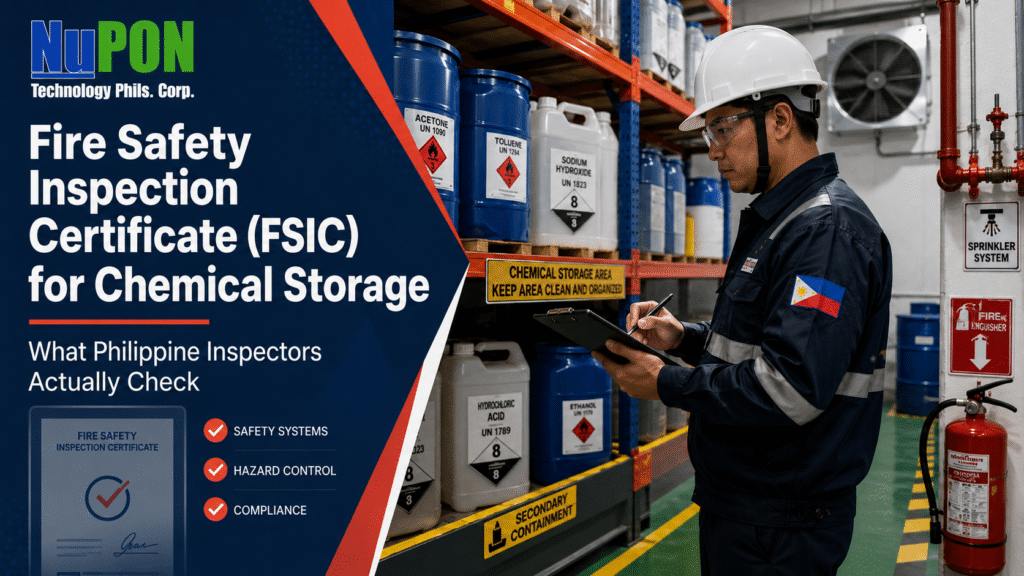
Last updated: July 2026
An inspector doesn’t ask whether your sulfuric acid is dangerous. He asks where it’s stored — and if the answer is “in a locked room” instead of “in a certified corrosive cabinet,” your Fire Safety Inspection Certificate renewal just got a lot harder.
Every facility that manufactures, uses, or stores corrosive chemicals in the Philippines is answerable to three different regulators at once — the Bureau of Fire Protection, the Department of Labor and Employment, and the DENR — and each one shows up with a different checklist. This guide breaks down what each actually requires, what a BFP inspector looks for during an FSIC walkthrough, and how a purpose-built storage cabinet clears most of it in one step.
What Is an FSIC, and Why Does It Cover Your Chemical Storage?
The Fire Safety Inspection Certificate (FSIC) is the document the Bureau of Fire Protection issues once it determines a facility’s fire safety construction, protective systems, and hazard controls are in place. It’s a prerequisite for your business permit, certificate of occupancy, and — for PEZA-registered plants — your PEZA clearance. No FSIC, no renewal.
Corrosive liquids are named directly in the Fire Code of the Philippines (RA 9514) as a hazardous material requiring specific fire safety measures for their manufacture, storage, handling, and use. That means an acid drum sitting in a storeroom isn’t just a labor or environmental concern — it’s a fire code item, and it’s one of the first things a BFP inspector will ask to see controlled.
The Three Regulators Your Storage Has to Satisfy at Once
| Regulator | Governing Law | What It Covers |
|---|---|---|
| Bureau of Fire Protection | RA 9514 — Fire Code of the Philippines | Fire safety measures for hazardous materials, FSIC issuance, occupancy classification |
| DOLE | OSH Standards Rule 1090; Department Order 136-14 (GHS) | Labeling, handling, and containment of corrosive/hazardous substances; workplace chemical safety programs |
| DENR-EMB | RA 6969 — Toxic Substances and Hazardous and Nuclear Wastes Control Act | Import, storage, and handling of chemicals on the Priority Chemicals List |
Three agencies, three sets of paperwork — but one storage cabinet, set up correctly, satisfies all three at once. That’s the part most facilities miss: they treat these as separate compliance projects when a single purpose-built cabinet closes the gap on all of them simultaneously.
What a BFP Inspector Actually Walks In Looking For
- Hazard labeling. Every container and every storage point needs visible, GHS-compliant hazard signage — not a handwritten note taped to a drum.
- Segregation from incompatible materials. Acids stored anywhere near bases, oxidizers, or flammable solvents is an automatic flag. Inspectors know that mixing these on a spill is how a small incident becomes a fire or gas release.
- Spill containment. A leak-tight sump or containment base under the storage point — not just a tray you added after the fact.
- Construction appropriate to the hazard. Corrosion-resistant coating, sealed seams, and — where flammable and corrosive materials share a space — fire-rated double-wall construction.
- Grounding and bonding. A built-in earth cable connection to control static discharge, particularly relevant for facilities also storing flammable solvents nearby.
- Clear egress. Storage that doesn’t block an exit path, fire extinguisher access, or a fire hose cabinet.
- Documentation on file. Safety Data Sheets and a current chemical inventory the safety officer can produce on request.
Miss two or three of these and the FSIC renewal turns into a re-inspection cycle — which means weeks of delay on a business permit your operations depend on.
Why a Purpose-Built Cabinet Is the Fastest Way to Clear the List
Most of the items on the checklist above aren’t solved by a procedure memo — the physical storage unit itself solves them. A cabinet built specifically for corrosive and acid storage handles labeling, containment, construction, and grounding in one purchase, rather than as five separate fixes.
NuPon’s Corrosive & Acid Safety Storage Cabinet line is built around exactly this checklist:
- Rated for both flammable and non-flammable corrosives — one cabinet instead of two separate hazard-specific units
- Double-wall construction with a 30mm insulating thermal barrier
- Blue, baked epoxy powder finish engineered to resist corrosive attack
- Sealed inlet/outlet jacket with a dual vent and 50mm suction-neck option for connection to an exhaust or suction system
- Adjustable shelves rated to support 90kg each
- Stainless steel door hinges and a self-closing latch with lock
- Built-in earth/ground cable for static control
- Prominent hazard label built into the door — no aftermarket signage needed
It comes in nine capacities, so the cabinet matches the actual volume on your floor instead of forcing you to over- or under-buy:
| Capacity | Typical fit |
|---|---|
| 4–12 Gal | QC/QA labs, pilot lines, small batch cleaning stations |
| 22–30 Gal | Single production line, electronics/PCB etching bench |
| 45–60 Gal | Metal finishing or plating bays, mid-size plants |
| 90–110 Gal | Full production floors, centralized chemical storerooms |
Frequently Asked Questions
Do I need a special cabinet for acid storage, or can I use a regular chemical cabinet?
Yes — acids and other corrosives need a cabinet built for chemical resistance, not a generic flammable-storage box. Standard steel flammable cabinets will corrode from the inside within months of contact with acid vapor, which is exactly what a BFP or DOLE inspector is trained to spot.
Does the FSIC inspection cover chemical storage, or is that a separate DOLE matter?
Both. The Fire Code (RA 9514) names corrosive liquids as a hazardous material requiring fire safety measures, which puts storage squarely inside the FSIC walkthrough. DOLE’s OSH Standards and GHS chemical safety program (D.O. 136-14) apply on top of that, covering labeling and workplace handling. Passing one doesn’t automatically satisfy the other, but a properly specified cabinet addresses the physical requirements both are checking for.
What happens if my facility fails the FSIC because of chemical storage?
The BFP will withhold the certificate until the deficiency is corrected and re-inspected, which stalls your business permit and occupancy renewal. For PEZA-registered facilities, that delay can also hold up your PEZA clearance.
Is ventilation required for acid storage cabinets in the Philippines?
It depends on the chemical. Highly volatile or fuming acids generally need ventilation to prevent a buildup of corrosive vapor; less volatile corrosives may not require active venting. Check the Safety Data Sheet for each chemical you store, and choose a cabinet — like NuPon’s dual-vent design with a 50mm suction-neck option — that gives you the option to connect to an exhaust system if you need it.
Can I store acids and flammable solvents in the same cabinet?
Only if the cabinet is explicitly rated for both, with proper internal segregation. NuPon’s Corrosive & Acid Safety Storage Cabinet line is rated for flammable and non-flammable corrosives together, but oxidizing acids (like concentrated nitric acid) should still be segregated from organic acids and from any flammable materials within the cabinet using separate shelves or secondary containment trays.
Talk to a Safety Officer Before Your Next Inspection
NuPon Technology Phils. Corp. is an ISO 9001:2015 and ISO 14001:2015 certified supplier, accredited under DTI–CIAP, PhilGEPS, and SOCOTEC, with 12 branches nationwide from Laguna to Cebu. Our team can help you match the right cabinet capacity to your actual storage volume before your next BFP or DOLE walkthrough.
View the full Corrosive & Acid Safety Storage Cabinet line or request a quote from our team.