
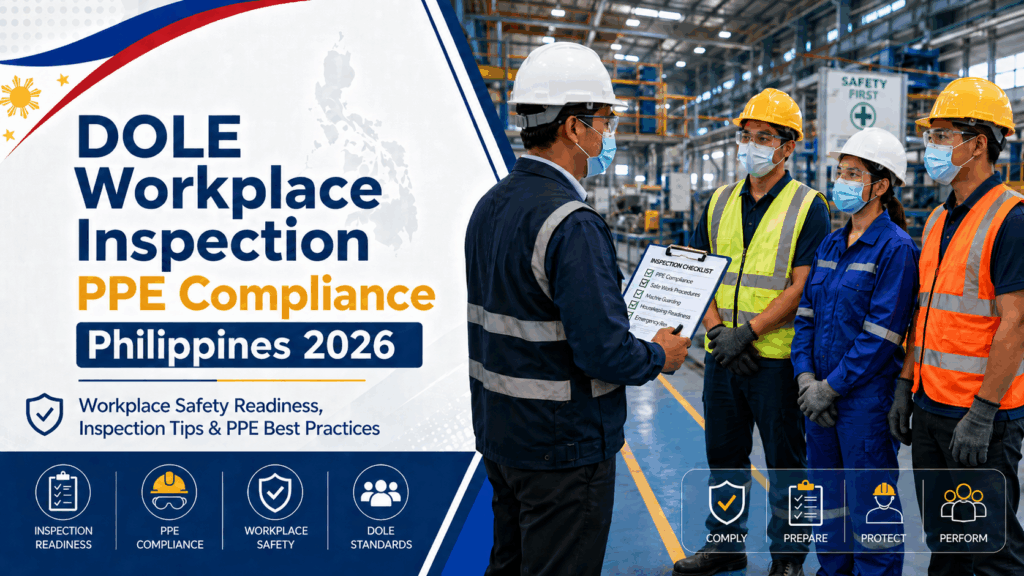
During a DOLE inspection in the Philippines, inspectors verify PPE availability and correct use, safety signage, the OSH program document, emergency preparedness, accident reporting records, safety officer appointment, and mandatory worker training — all under RA 11058 and DOLE D.O. 198-18. Fines range from ₱20,000 to ₱100,000 per violation, and DOLE can issue a Work Stoppage Order for imminent danger situations without prior notice.
If you have not thought about a DOLE inspection lately, the timing could not be worse to stay unprepared. As of June 2026, the Department of Labor and Employment is actively running its High-Impact, High-Visibility Inspection (HIHVI) program on construction sites and manufacturing facilities across the Philippines — with inspectors specifically flagging workplaces where workers are not wearing the proper personal protective equipment (PPE).
The numbers behind the crackdown are sobering: from January to July 2025, there were 217 reported workplace accidents in the Philippines, resulting in 153 deaths and 255 injuries — nearly one workplace fatality every single day. DOLE’s response has been to intensify inspections, increase penalties, and expand its reach into industries and regions that have historically received less oversight.
This guide covers exactly what DOLE inspectors look for, which violations are most commonly cited, how much non-compliance costs, and what your safety team should have ready before an inspector walks through your door.
Why DOLE Inspections Are Intensifying in 2026
The HIHVI Program: DOLE’s 2026 Inspection Offensive
The High-Impact, High-Visibility Inspection (HIHVI) program is DOLE’s primary enforcement mechanism for workplace safety standards. In June 2026, DOLE conducted HIHVI inspections across construction sites in La Union from June 16 to 19, with particular attention to PPE availability, safety signage installation, emergency preparedness protocols, and accident prevention programs. The DOLE Ilocos Regional Director stated that the program reflects the agency’s commitment to fostering a culture of safety and accountability — and that it will continue as a sustained, nationwide initiative.
This is not a one-province campaign. The HIHVI program runs across all DOLE regional offices, meaning manufacturing and construction facilities in Laguna, Cavite, Batangas, Metro Manila, and every other major industrial hub can expect the same level of inspection intensity.
153 Workplace Deaths in 2025 — The Reason DOLE Is Acting Now
According to DOLE workplace accident data compiled by Sprout Solutions, there were 217 reported workplace accidents in the Philippines from January to July 2025, resulting in 153 deaths and 255 injuries. That is nearly one fatality per working day — a statistic that has prompted DOLE to shift from advisory-style engagement to active enforcement with financial penalties.
DOLE marked the World Day for Safety and Health at Work on April 28, 2026, with OIC Secretary Benedicto Ernesto R. Bitonio, Jr. emphasizing that the agency’s goal is not merely to reduce accidents or enforce compliance, but to ensure dignity, respect, and well-being in every Philippine workplace. The April 2026 event also included the signing of a Memorandum of Agreement with the University of the Philippines School of Labor and Industrial Relations (UP SOLAIR) to advance OSH research and policy development.
What Does DOLE Actually Check During an Inspection?
DOLE Labor Laws Compliance Officers (LLCOs) and OSH inspectors follow a structured assessment framework during both announced and unannounced workplace inspections. Here is what they evaluate:
1. PPE Availability and Correct Use
Under Section 8 of RA 11058, every employer must provide workers with appropriate PPE free of charge — specifically: protective equipment for eyes, face, hands, and feet; lifelines, safety belts or harnesses; gas or dust respirators or masks; and protective shields whenever necessary due to hazardous work processes or environments.
Inspectors verify that:
- PPE is physically available on site for all workers exposed to hazards
- PPE is of an appropriate type, tested, and approved by DOLE
- Workers are actually wearing and correctly using their PPE during work
- PPE selection is based on the evaluation and recommendation of a qualified Safety Officer
2. Safety Signage and Devices
Under Section 9 of RA 11058, all workplaces must display safety signage and devices in prominent positions in a language understandable to all workers. Inspectors check that signage is posted at strategic locations, uses colors and symbols compliant with DOLE standards, and clearly communicates hazard warnings, mandatory actions, and emergency directions.
3. OSH Program Documentation
Every workplace covered by the OSH Standards must maintain a written OSH program appropriate to its size and level of risk. Inspectors request this document and review it for completeness — including hazard identification, risk assessment, control measures, emergency response plans, and OSH training schedules. A copy must also be on file with the relevant DOLE regional office.
4. Safety Officer Appointment and OSH Committee
Philippine law requires employers to appoint qualified Safety Officers and organize an OSH Committee, with the composition depending on company size and risk level. Inspectors verify that Safety Officers hold valid DOLE-accredited training certifications and that the OSH Committee is formally organized and active.
5. Worker Training Records
Inspectors review training records to confirm that all workers have received the OSH orientation required under RA 11058, and that high-risk task workers have completed required refresher training. For construction sites, the 40-hour Construction Occupational Safety and Health (COSH) training and standard first aid and basic life support (BLS) certification are specifically verified.
6. Accident Reporting Compliance
Under Rule 1050 of the DOLE OSH Standards, employers are legally required to report work-related accidents using the Work Accident/Illness Report (WAIR) within 30 days of the incident to the DOLE regional office. The Annual Exposure Data Report (AEDR) must be submitted on or before January 30 of the following year. Inspectors check for complete, up-to-date accident logs and submitted reports.
7. Construction Safety and Health Program (CSHP)
For construction projects specifically, DOLE requires submission of a Construction Safety and Health Program (CSHP) through the official DOLE Online Compliance Portal. As of January 2026, DOLE migrated CSHP submissions to a new online system at cshp.dole.gov.ph — all previous submission platforms have been deactivated. Inspectors verify that an approved CSHP is on file for every active construction project.
Most Common PPE and OSH Violations DOLE Finds
Based on DOLE Bureau of Working Conditions (BWC) inspection data, here are the violations most frequently cited during Philippine workplace inspections:
Real Data Point: In a two-week DOLE BWC inspection of 95 construction sites in Metro Manila, 52 out of 95 sites (55%) were found violating basic OSH standards. The top violation in every category was the lack of personal protective equipment — including safety shoes, helmets, harnesses, gloves, and goggles. Where PPE existed, it was often found to be inadequate or being used incorrectly. (Source: DOLE Bureau of Working Conditions / Philippine Daily Inquirer)
Violation #1 — Missing or Inadequate PPE
The single most common DOLE citation across construction and manufacturing sites in the Philippines. Inspectors find workers without safety shoes, helmets, harnesses, gloves, or goggles — or find that the PPE on site does not meet DOLE-approved standards. Providing “any” PPE is not enough — it must be the appropriate type as tested and approved by DOLE for the specific hazard.
Violation #2 — No Designated Safety Officer on Site
Many smaller construction sites and manufacturing facilities operate without a certified, on-site Safety Officer. This is a direct violation of RA 11058 and results in a citation during inspection.
Violation #3 — No OSH Committee
Workplaces above the threshold employee count (10 or more workers for non-hazardous industries; 1 or more for highly hazardous industries) are required to have a formally constituted OSH Committee. DOLE inspectors regularly find that this committee either does not exist or exists only on paper without documented meetings or activities.
Violation #4 — Incomplete or Missing Training Records
OSH orientation training for all workers is mandatory. High-risk industries require additional certifications. DOLE inspectors find that training records are either absent, incomplete, or show training occurred only once without required refresher cycles.
Violation #5 — No Safety Signage
Missing or inadequate safety signage — particularly in construction sites, chemical storage areas, and electrical rooms — is consistently among the top five citations in DOLE inspection reports.
Violation #6 — Late or Missing Accident Reports
Failure to submit the WAIR within 30 days and the AEDR by January 30 annually results in administrative violations. DOLE inspectors review the accident log during site visits and cross-reference it with submitted reports to detect under-reporting.
| Violation | Classification | Potential Fine |
|---|---|---|
| Missing or inadequate PPE | Serious to Imminent Danger | ₱50,000–₱100,000 per violation |
| No Safety Officer on site | Serious | ₱50,000 per violation |
| No OSH Committee | Less Serious | ₱20,000–₱50,000 |
| Incomplete training records | Less Serious | ₱20,000–₱50,000 |
| Missing safety signage | Other-than-Serious | ₱20,000–₱50,000 |
| Late or missing accident report (WAIR/AEDR) | Less Serious | ₱20,000–₱50,000 |
Penalties for Non-Compliance Under RA 11058
Administrative Fines: ₱20,000 to ₱100,000 Per Violation
Republic Act No. 11058 introduced a significantly tougher penalty structure compared to the old Labor Code, which previously imposed fines of only up to ₱1,000 for OSH violations. Under the current law:
- Other-than-serious violations (record-keeping lapses, minor non-compliance without direct risk) — administrative fine of not less than ₱20,000 and not more than ₱50,000 per violation
- Serious violations (failure to provide fall protection, inadequate ventilation, lack of required PPE) — administrative fine up to ₱50,000 per violation
- Violations exposing workers to death, serious injury, or serious illness — fine of ₱100,000 per violation
These fines are imposed per violation — meaning a workplace with five separate PPE violations, no Safety Officer, and no OSH Committee could face a combined fine exposure significantly larger than any single violation figure suggests.
Work Stoppage Orders: When DOLE Shuts You Down
Beyond financial penalties, DOLE has the authority to issue a Work Stoppage Order (WSO) for imminent danger situations — defined as conditions posing an immediate threat to life or health, such as unguarded machinery, confined space entry without atmospheric testing, or exposure to toxic substances without controls. A WSO halts all operations at the affected site until the imminent danger is eliminated and DOLE issues a clearance to resume work.
The cost of a work stoppage — in lost production, contractor penalties, and reputational damage with clients — typically dwarfs the administrative fine itself.
How to Prepare: A Safety Officer’s Pre-Inspection Checklist
Use this checklist to assess your workplace’s readiness before a DOLE inspection visit. Items are organized by what inspectors check first:
| Item | What to Verify | Status |
|---|---|---|
| PPE Inventory | All workers in hazardous areas have appropriate, DOLE-approved PPE available and are using it correctly | ☐ Ready |
| PPE Documentation | PPE issuance records maintained, signed by each worker; Safety Officer’s written PPE recommendation on file | ☐ Ready |
| Safety Officer | Certified Safety Officer physically present on site; valid DOLE-accredited certification available for inspection | ☐ Ready |
| OSH Committee | OSH Committee formally constituted with documented meeting minutes; chairperson and members identified | ☐ Ready |
| OSH Program Document | Written, current OSH program available on site and filed with DOLE; includes hazard assessment, controls, and emergency plan | ☐ Ready |
| Safety Signage | All hazard zones, emergency exits, first aid stations, and PPE requirement areas are clearly marked in compliant signage | ☐ Ready |
| Training Records | All workers have OSH orientation on file; construction workers have COSH and BLS certificates; refresher schedules are documented | ☐ Ready |
| WAIR / AEDR | All past accidents reported via WAIR within 30 days; last AEDR submitted by January 30 of the current year | ☐ Ready |
| CSHP (Construction) | Approved CSHP on file via DOLE Online Compliance Portal (cshp.dole.gov.ph); approval number available for inspection | ☐ Ready |
| First Aid Facilities | First aid kits stocked and accessible; certified first aider on each shift; clinic or medical support arrangement documented | ☐ Ready |
Pro Tip for Safety Officers: Keep a dedicated DOLE Inspection Binder on site at all times — a physical folder containing your OSH program, Safety Officer certification, OSH Committee composition, training attendance sheets, PPE issuance records, latest WAIR submissions, and AEDR. When a DOLE inspector arrives, producing this binder immediately demonstrates a proactive culture of compliance and significantly reduces the time inspectors spend on your site.
Industries Under the Highest DOLE Scrutiny in 2026
DOLE classifies workplaces as either highly hazardous, hazardous, or non-hazardous — with inspection frequency and penalty severity scaled accordingly. The following industries face the highest level of DOLE inspection activity in 2026:
- Construction — The highest-priority sector for DOLE inspection due to fall hazards, unguarded machinery, and the highest raw number of workplace fatalities. The HIHVI program runs continuously in construction across all regions.
- Electronics and Semiconductor Manufacturing — PEZA-zone facilities face dual scrutiny from both DOLE and PEZA environmental health and safety (EHS) auditors. ESD safety, chemical handling, and clean room PPE compliance are all inspection targets.
- Chemical Processing and Petrochemicals — Particularly in Batangas (Shell, Petron, and downstream facilities), where confined space entry, chemical vapor exposure, and flame-resistant PPE requirements are primary inspection targets.
- Food and Beverage Processing — Increasingly targeted due to heat stress, machinery guarding, and hygiene-related PPE requirements.
- BPO and Office Environments — Now under DOLE scrutiny for psychosocial hazards, ergonomic risks, and mental health — highlighted at World Safety Day 2026.
How NuPON Technology Phils. Corp. Helps You Stay DOLE-Compliant
For manufacturing and construction companies in Laguna, Cavite, Batangas, and Metro Manila, maintaining a current, compliant PPE inventory is the fastest way to close the most common DOLE inspection gaps. NuPON Technology Phils. Corp. (NTPC) has been supplying ISO 9001:2015 and ISO 14001:2015 certified PPE to Philippine industries since 2000, with specific experience supporting PEZA-zone clients through DOLE and customer safety audits.
NuPON can help your facility address the top DOLE violations directly:
- ✅ PPE Supply — Full range of DOLE-relevant PPE: helmets, safety shoes, harnesses, gloves, goggles, respiratory protection, coveralls, and ESD-safe garments. View the PPE catalog
- ✅ Product Documentation — Technical data sheets, product certifications, and compliance documentation provided with every supply — ready for your DOLE inspection binder
- ✅ Safety Signage — DOLE-compliant safety signage supply for construction sites, manufacturing floors, chemical storage areas, and emergency evacuation routes
- ✅ PPE Assessment Support — NTPC’s technical team can assist in reviewing your workplace’s PPE requirements by hazard type, ensuring your selections match RA 11058 and DOLE OSHS Rule 1080 requirements
- ✅ Fast Delivery — Headquarters in Santa Rosa City, Laguna, puts NTPC at the center of the CALABARZON industrial corridor for rapid supply to Laguna Technopark, LIIP, Lima Technology Center, First Cavite Industrial Estate, and surrounding PEZA zones
Frequently Asked Questions About DOLE Inspections in the Philippines
What does DOLE check during a workplace inspection in the Philippines?
DOLE inspectors check PPE availability and correct use, safety signage, OSH program documentation, emergency preparedness, accident reporting records, safety officer appointment, OSH committee formation, and mandatory training records under RA 11058 and DOLE D.O. 198-18. Inspectors may also review payroll records and general labor standards compliance during the same visit.
What are the fines for PPE violations under RA 11058 in the Philippines?
Under RA 11058, fines for other-than-serious violations range from ₱20,000 to ₱50,000 per violation. When a violation exposes a worker to death, serious injury, or serious illness, the fine is ₱100,000 per violation. DOLE may also issue a Work Stoppage Order for imminent danger situations, halting all operations until the hazard is corrected and DOLE issues a clearance.
Can DOLE inspect a workplace without prior notice in the Philippines?
Yes. Under RA 11058 and the Labor Laws Compliance System (LLCS), DOLE Labor Laws Compliance Officers (LLCOs) may conduct both announced and unannounced workplace inspections. Employers are required to allow DOLE inspectors access to the premises, records, and workers at all times. Refusing or obstructing a DOLE inspection is itself a violation.
What PPE is mandatory under Philippine law?
Under Section 8 of RA 11058, employers must provide free PPE for eyes, face, hands, and feet, plus lifelines, safety belts or harnesses, gas or dust respirators or masks, and protective shields whenever necessary due to hazardous work processes or environments. All PPE must be of a type tested and approved by DOLE. The specific types required depend on the Safety Officer’s evaluation of workplace hazards.
What triggers a DOLE inspection in the Philippines?
DOLE inspections are triggered by routine scheduling under the HIHVI program, a worker complaint filed with DOLE, a reported workplace accident, industry-wide enforcement campaigns, or failure to comply with a previous compliance order. High-risk industries, including construction and manufacturing, are prioritized for more frequent inspections regardless of complaint history.
Conclusion: The Cost of Being Unprepared Is Higher Than the Cost of Compliance
A DOLE inspection in 2026 is not the same as it was five years ago. With 153 workplace deaths recorded in just seven months of 2025, and the HIHVI program actively visiting construction and manufacturing sites across the Philippines right now, the question for Safety Officers and employers is not whether a DOLE inspector will come — it is whether you will be ready when one does.
The compliance gaps that trigger citations and fines are, in most cases, preventable: the right PPE in the right quantities, worn correctly, documented properly, with a qualified Safety Officer overseeing it all. The companies that invest in building this foundation before an inspector arrives are the ones that walk away with a Certificate of Compliance instead of a Compliance Order — and without the operational disruption of a Work Stoppage Order.
🛡️ Is Your PPE Ready for a DOLE Inspection?
NuPON Technology Phils. Corp. supplies ISO 9001:2015-certified PPE across the Philippines — with full product documentation ready for your DOLE inspection binder. From safety helmets and harnesses to ESD-safe gloves and respiratory protection, we help CALABARZON manufacturers close PPE compliance gaps fast.
Request a PPE Compliance Quotation
📍 Filsyn Corp Compound, Brgy. Don Jose, Santa Rosa City, 4026 Laguna
🌐 www.nuponcorpphils.com